Ergonomic Chair for a Small Space: Footprint Guide
In a tiny apartment, the chair is often the biggest single object in your workspace. It rolls, it swivels, it needs room to push back from the desk — and unlike a monitor or a lamp, it claims floor space whether you’re sitting in it or not.
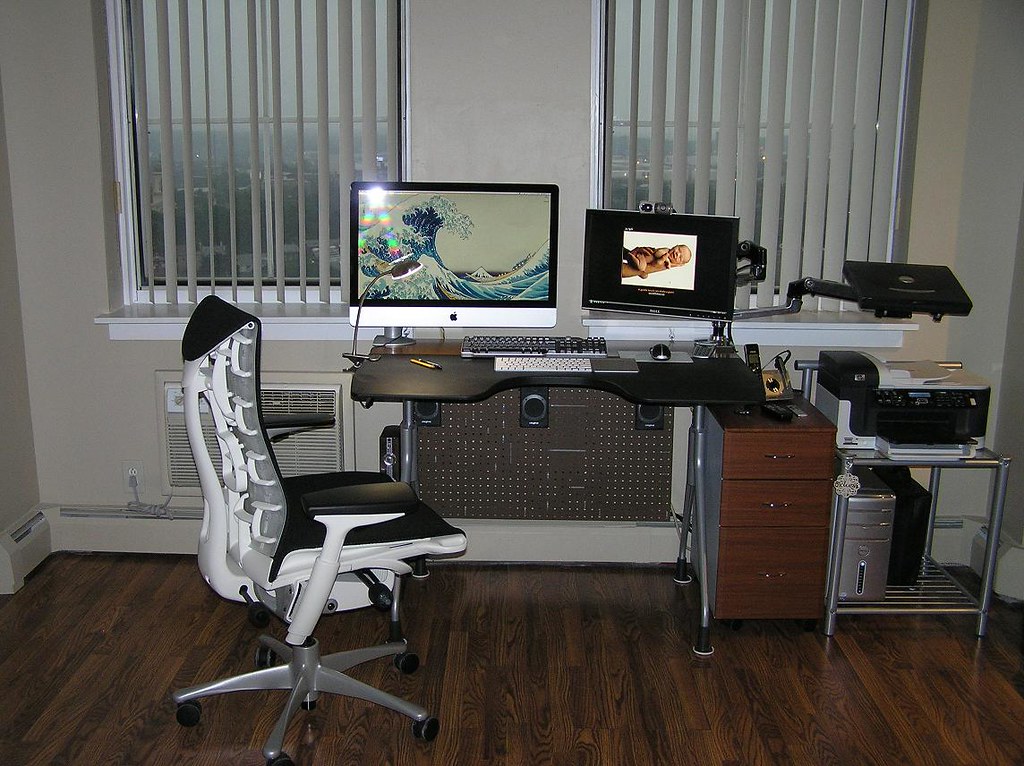
Most chair guides start with lumbar support and recline tension. That’s backwards for small rooms. If a chair doesn’t physically fit your space, none of its ergonomic features matter. So we’re going to start where your floor plan starts: footprint.
This is the hub for everything we cover on small-space seating. By the end, you’ll know how to measure your space, what “compact” actually means, and how to get real ergonomic support out of a chair that doesn’t dominate the room.
Why Footprint and Base Size Matter Most in Small Rooms
A chair’s footprint isn’t just the seat. It’s the diameter of the five-star base — the wheeled “star” at the bottom — plus the clearance you need to move it.
In a standard office, that base disappears under a big desk. In a 400-square-foot studio where your desk is wedged between the bed and the kitchen, the base is the part that bumps the bed frame when you stand up.
The base is wider than you think
Most rolling task chairs have a base measuring roughly 24 to 27 inches across (about 60 to 68 cm). That’s the widest point of the chair, and it sits at floor level where you can’t see it while you’re working.
If your usable floor zone is only 30 inches deep, a 26-inch base leaves you almost no room to scoot back. You end up perched at the desk’s edge, which wrecks your posture — the exact problem an ergonomic chair is supposed to solve.
Smaller bases exist, with a tradeoff
Some compact chairs use a narrower base or a four-point base instead of five. A narrower base saves floor space, but a five-star base is the stability standard for a reason: it resists tipping when you lean or reach. If you go narrower, prioritize a low seat-to-floor center of gravity and avoid aggressive recline.
Quick rule: measure your chair’s base diameter, not just the seat. The base is what eats your floor.
For specific compact models that balance base size against stability, see Best Compact Ergonomic Chairs for Small Apartments.
The Ergonomic Essentials (and How to Get Them in a Compact Chair)
A small chair doesn’t have to be a bad chair. The four essentials below are achievable in a compact frame — you just have to know which adjustments to insist on.
Seat height
Your feet should rest flat on the floor with knees at roughly a 90-degree angle and thighs parallel to the ground. For most adults, that lands the seat surface somewhere around 16 to 21 inches off the floor, but your body decides the exact number, not the spec sheet.
Pneumatic (gas-lift) height adjustment is non-negotiable. It’s standard on nearly every task chair and costs you nothing in footprint. If your feet dangle, add a footrest; if your knees rise above your hips, you need a taller setting or a different chair.
Seat depth
This is the make-or-break dimension for small bodies and the one compact chairs most often get right by accident — their seats are simply shorter.
Aim for two to three finger-widths of clearance between the front edge of the seat and the back of your knees. Too deep, and you either slump to reach the backrest or cut off circulation behind your knees.
A shorter seat pan is genuinely an advantage in a tiny space: less seat means a smaller footprint and a better fit for shorter legs.
Lumbar support
Lumbar support fills the natural inward curve of your lower back so you’re not slumping into a C-shape. You don’t need a huge backrest to get it.
Adjustable lumbar (height and sometimes depth) is ideal because it lets you place support exactly where your curve sits. If a compact chair has only fixed lumbar, sit in it long enough to confirm the bump lands on your lower back, not your mid-back.
A small lumbar pillow is a cheap fix if a chair is right on every other count.
Armrests
Armrests support your forearms so your shoulders aren’t doing the work of holding your arms up all day. But in a small space, fixed armrests are the enemy: they stop the chair from sliding under the desk, forcing it to live further out in the room.
Two small-space-friendly options:
- Adjustable armrests that lower out of the way, ideally 3D or 4D (height, width, depth, pivot).
- No armrests at all — an armless chair tucks fully under the desk and reclaims that floor space (more on this below).
Chair Types That Work in Tiny Spaces
There’s no single “best” small-space chair — there’s the best one for your body, your desk, and your floor. Here are the four types worth considering.
Compact task chairs
These are conventional ergonomic chairs designed in smaller proportions: shorter seat pan, narrower base, lower-profile back. They’re the most familiar option and usually keep the adjustments that matter (height, lumbar, tilt).
Best for: people who want a “normal” chair experience without the bulk. This is the default starting point for most renters.
Armless chairs
Drop the armrests and the chair slides completely under the desk when you’re not using it. In a studio, that can be the difference between a walkable room and an obstacle course.
The catch: you lose forearm support, so your desk height and keyboard position have to be dialed in to keep your shoulders relaxed.
Best for: very tight footprints, and people whose desk already supports their forearms well.
Kneeling chairs
A kneeling chair tilts your pelvis forward and shifts some weight onto shin pads, encouraging an upright spine without a tall backrest. Many have a compact footprint and no wide wheeled base.
They’re not for everyone or for all-day use — they take adjustment, and they put pressure on the shins. Treat them as a posture option to alternate with, not a guaranteed all-day seat.
Best for: people who want an active alternative and don’t mind switching positions through the day.
Active stools and saddle seats
A backless stool or saddle seat has the smallest footprint of all and encourages you to engage your core and shift position frequently. Many adjust in height and can roll fully out of the way.
The tradeoff is no back support, so they suit shorter focused sessions better than eight-hour marathons. The best small-space setups often pair a stool with a supportive chair and swap between them.
Best for: minimalists, standing-desk users who perch, and anyone who fidgets.
Fitting Your Body: Petite, Short, and Tall
A chair that fits the room but not your body is still the wrong chair. Standard ergonomic guidance is built around an “average” adult, and a lot of people aren’t average.
Petite and short users
If your feet dangle or the seat hits the back of your knees, the chair is too big — and most standard chairs are.
Look for a shorter seat pan (often around 15 to 17 inches deep), a lower minimum seat height, and lumbar support that sits low enough for your back. A footrest solves dangling feet on chairs that won’t drop far enough.
We’ve gathered specific picks here: Best Ergonomic Chairs for Petite / Short People.
Tall users
Taller bodies need the opposite: a higher maximum seat height, a deeper seat pan so your thighs are supported, and a backrest tall enough to reach your shoulder blades.
The challenge in a small space is that taller, larger chairs usually have larger bases. Prioritize adjustability and seat depth, and be honest about whether a truly tall-friendly chair fits your floor — sometimes a slightly larger base is worth it for the support.
A simple body-fit check
Sit all the way back. Can you get two to three fingers behind your knees, feet flat, knees level with or slightly below your hips, lower back supported, shoulders relaxed? If yes, the chair fits you. The room comes second to that.
Measuring Your Space: Turning Radius and Under-Desk Clearance
Before you buy anything, spend ten minutes with a tape measure. This is the step most people skip and most regret.
Map your usable floor zone
Measure the open floor directly in front of your desk — width and depth — to the nearest obstacle: a bed, a wall, a couch, a doorway swing.
You need enough depth to push the chair back and stand up: a good target is the chair’s base diameter plus roughly 12 to 18 inches of clearance behind it.
Turning radius
A swivel chair needs room to rotate without clipping furniture. As a quick estimate, the chair needs a clear circle a bit wider than its base diameter to turn freely.
If your zone is tight, a chair that swivels but doesn’t need to roll far can still work — you just keep the rotation in place rather than wheeling around.
Under-desk clearance
Measure the height from the floor to the underside of your desk (including any drawers or aprons). Compare it to the chair’s armrest height at its lowest setting.
If the armrests don’t clear the desk, the chair can’t tuck in — and a chair that can’t tuck in lives permanently in your walking space. This is the single most common small-space chair mistake, and it’s why armless or low-arm chairs win so often.
Write the numbers down
Keep three numbers handy when you shop: usable floor depth, under-desk clearance height, and your ideal seat height. Match the chair’s specs to those before you fall for a photo.
Caring for Your Floors (and Your Deposit)
Renters, this section is for you. A rolling chair can scuff hardwood, dent vinyl, and shred a cheap apartment carpet — and that comes out of your deposit.
Pick the right casters
Hard floors (wood, laminate, tile) need soft, rubberized casters or polyurethane wheels designed for hard surfaces. Carpet does better with harder wheels. Using the wrong type either scratches the floor or refuses to roll.
Many chairs ship with carpet-style wheels by default, so check before assuming.
Use a chair mat or area rug
A chair mat protects the floor and makes hard-surface rolling smoother. In a small room, a low-profile mat or a flat-weave area rug under the chair zone does double duty: floor protection plus a visual anchor for the workspace.
Pick a mat sized to your usable floor zone so it doesn’t curl up against the bed or wall.
Consider glides over casters
If you barely move once seated — common in a tight setup — you can swap wheels for static glides or use a stationary base. Less rolling means less floor wear and no chance of drifting into the bed mid-call.
Putting It Together
Choosing an ergonomic chair for a small space is a sequence, not a wish list:
- Measure first — usable floor depth, under-desk clearance, turning room.
- Start with footprint — base diameter and whether the chair tucks under the desk.
- Confirm the four essentials — seat height, seat depth, lumbar, and armrests that get out of the way.
- Fit it to your body — especially if you’re petite, short, or tall.
- Protect your floor — right casters, a mat, and your deposit stays intact.
Get the footprint right and the rest follows. A compact chair that fits both your room and your back is absolutely achievable — you just have to shop in that order.
Ready for specific models? Start with Best Compact Ergonomic Chairs for Small Apartments, and if standard chairs never quite fit you, head to Best Ergonomic Chairs for Petite / Short People.