Best Compact Ergonomic Chairs for Small Apartments
TinyOfficeLab is reader-supported. We may earn a commission from links on this page, at no cost to you. As an Amazon Associate we earn from qualifying purchases.
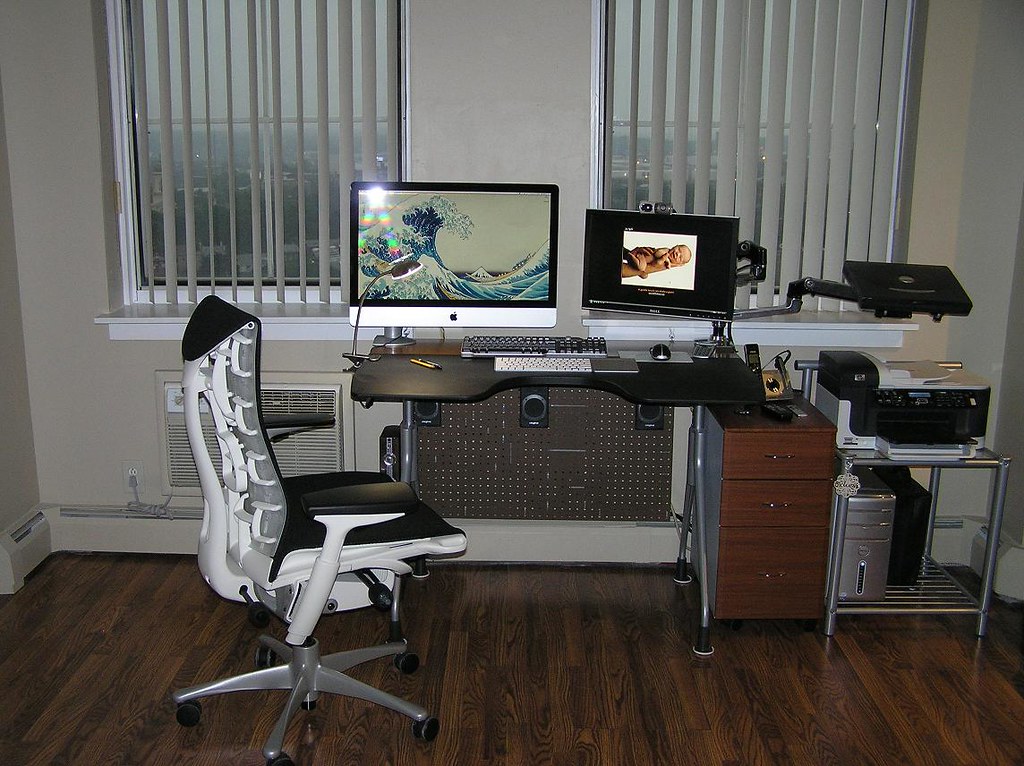
When your “office” is the corner of a bedroom or a fold-down desk in a 400-square-foot apartment, the usual ergonomic chair advice falls apart. Most “best office chair” lists assume you have a dedicated room and a deep desk to roll back into. You don’t. You have a narrow walking path, a shallow desk, and a security deposit you’d like to get back.
This guide flips the priority. Instead of starting with the biggest, most adjustable throne, we start with footprint — then find the most ergonomic support that fits inside it. Because the best chair for a tiny space is the one you can actually push all the way under your desk at the end of the day.
The picks below are compiled from manufacturer specifications and owner reviews. We haven’t lab-tested every model ourselves; where we mention how a chair performs, that reflects published specs and the consensus of verified buyers. Always measure your own desk and space against a chair’s listed dimensions before ordering.
What “Compact Ergonomic” Actually Means
A small chair isn’t automatically a compact one. The number that matters most is the wheelbase diameter — the width of the five-star base measured caster-tip to caster-tip. That base is usually wider than the seat, and it’s what stops a chair from tucking fully under a desk or sliding past a doorway.
For small spaces, you’re looking for three things at once:
- A small wheelbase that disappears under the desk so the chair isn’t eating floor space when not in use.
- A low or trimmed-down armrest setup — armless, flip-up, or low-profile — so you can pull close to a shallow desk.
- Genuine ergonomic support in that smaller frame: adjustable seat height, decent lumbar support, and a seat depth that fits your legs.
Skip any one of these and you’ve just bought a small chair, not a compact ergonomic one.
Footprint First: How to Measure Before You Buy
This is the step almost everyone skips, and it’s why so many “small” chairs end up blocking a closet door. Spend ten minutes here and you’ll avoid a return.
Measure your desk clearance
Most compact desks for apartments are around 24 inches deep. Measure the height of the underside of your desk (the apron or drawer, not the desktop) and the clear depth underneath. A chair only tucks away fully if its armrests clear the desk underside and its wheelbase fits in the open space beneath.
A simple way to do this: run a tape measure from the floor to the underside of the desk apron (or the bottom of any drawer), and note the number. That figure is the ceiling your chair’s armrests have to clear if you want to roll all the way under.
Measure the wheelbase, not the seat
When you read a product listing, look for the base diameter or “wheelbase” spec — not the seat width. A typical full-size office chair base runs about 26–27 inches across. Compact models often come in noticeably smaller. The smaller that number, the more chair you can hide under the desk.
Measure your turning radius and walking path
In a tiny room, the chair has to swivel and roll without hitting the bed, the wall, or a doorway. Here’s the quick method:
- Set the chair in its normal working spot.
- Measure from the center of the chair to the nearest obstacle on each side.
- The chair needs roughly half the wheelbase diameter of clearance to swivel in place, plus a few inches to scoot out and stand up.
If you can’t get that clearance, a smaller base or even an armless stool may serve you better than a wider chair you can never fully use.
How to Set Up an Ergonomic Desk in a Small Apartment
The Non-Negotiable Ergonomic Features (Even in a Small Frame)
Compact does not mean you give up your back. These are the supports worth protecting, even when you’re trimming everything else.
Adjustable seat height
This is the single most important ergonomic adjustment, and almost every gas-lift chair has it. The standard guidance: your feet rest flat on the floor, knees roughly level with or slightly below your hips, and your forearms parallel to the desktop when typing. In a small space, also confirm the height range — short users and tall desks both need a wider range than the budget default.
If your seat height range is too short for your desk, a compact office chair with a wider lift range — or a small footrest — closes the gap without forcing you into a bulkier model.
Lumbar support
Your lower back has a natural inward curve, and a good chair fills it so you’re not slumping. In a compact chair you may not get a separately adjustable lumbar pad — but you should at least get a contoured backrest that supports the lower back. A small mesh back with a built-in lumbar curve is often a better small-space choice than a big padded throne.
Seat depth
Seat depth is quietly critical and often overlooked on small chairs. With your back against the backrest, you want roughly two to three finger-widths of gap between the front edge of the seat and the back of your knees. Too-deep seats force you to slump forward; too-shallow seats leave your thighs unsupported. Some compact chairs offer seat-depth adjustment (a sliding seat pan) — a real bonus in a smaller frame.
Recline and a small tilt
Even a basic tilt that lets you lean back periodically reduces sustained spinal load. You don’t need a full multi-tilt mechanism in a tiny room — a simple tension-adjustable tilt is plenty.
Armrests: The Make-or-Break Feature for Shallow Desks
In a small apartment, armrests are usually the difference between tucking your chair away and not.
- Armless: The smallest footprint and the easiest to slide fully under a shallow desk. Great for very tight corners and for people who rest their forearms on the desk anyway. The trade-off is no arm support when reclining.
- Flip-up arms: The best of both worlds for tiny spaces — support when you want it, and you flip them up to roll the chair under the desk and reclaim the floor.
- Low-profile / height-adjustable arms: If you want arms that stay down, make sure they drop low enough to slide beneath your desk apron. Measure first.
For most renters with a shallow desk, flip-up or armless wins.
Best overall compact: Sihoo M59AS Petite Ergonomic Chair
The M59AS is one of the few mainstream ergonomic chairs designed for a small frame rather than scaled down from a large one. Sihoo lists it for users roughly 4’11” to 5’6″, and it pairs that smaller seat with 3D flip-up armrests — they adjust for support while typing, then fold up 90 degrees so you can push the chair under a shallow desk and reclaim the floor. The dual-section mesh back has a dynamic lumbar section that flexes with your lower back, and weight capacity is rated to 300 lb.
It’s the most flexible all-rounder here for a renter who wants real adjustability without a full-size footprint. Owners consistently praise the fit for shorter users and the back support; the most common gripe is that assembly takes a bit of patience. Pricing sits in the mid tier for ergonomic task chairs.
Chair vs. Stool vs. Kneeling Chair: Choosing for a Tiny Room
A traditional chair isn’t the only answer. In the smallest spaces, the seating type matters as much as the model.
The compact task chair
The default and the most ergonomic all-rounder for full workdays. Choose this if you sit for several hours at a time and want proper back support. Prioritize a small wheelbase and flip-up/armless arms.
Best under-desk tuck: FelixKing Ergonomic Mesh Office Chair with Flip-Up Armrests
If your single priority is getting the chair completely out of the way at night, this is the value play. The FelixKing mesh task chair uses 90-degree flip-up armrests so it slides fully under a desk, with a breathable mesh back, built-in lumbar support, height adjustment, and a tilt/recline mechanism. Weight capacity runs around 300 lb depending on the variant (the closely related KERDOM models share the same flip-up design and a similar 250–300 lb rating).
This is an entry-to-mid-tier chair, so the adjustments are simpler than the Sihoo’s — but for the price, owners are happy with the comfort and especially the space-saving arms. Confirm the listed seat and back dimensions against your frame before buying, since the fit is more generic than a dedicated petite model.
Best armless: VigorPow Armless Mesh Office Chair
When the desk is genuinely shallow and you rest your forearms on the desktop anyway, armless is the smallest, simplest footprint you can get — nothing to flip, nothing to clear. The VigorPow armless mesh chair is a no-arms task chair with a contoured, body-hugging mesh back for lower-back support, height adjustment, and a five-star rolling base that tucks straight under a desk. It’s compact enough that it doubles as a kid’s or guest seat.
The trade-off is the obvious one: no arm support when you lean back, and a simpler tilt than larger chairs. For a tight corner or a fold-down desk, that’s usually a fair trade. It sits in the budget-to-entry tier.
Best budget: EDX Armless Small Home Office Desk Chair
The most affordable way into a compact ergonomic setup. The EDX is a low-back armless task chair built around a narrow base and small profile that slides fully under a desk, with a C-shaped backrest and Y-shaped lumbar support sized for the lower back. The low back and no-arms design keep both the footprint and the price down.
Don’t expect deep adjustability — this is a starter chair for a dorm, a study nook, or a part-time work corner, and reviewers treat it as exactly that. But for genuinely tight spaces and tight budgets, it covers the ergonomic basics: adjustable height, lumbar contact, and a footprint that disappears.
The active stool / saddle stool
A backless stool has the smallest footprint of all — often no wheelbase wider than the seat — and tucks completely out of the way. It encourages an upright, active posture and is ideal for standing-desk converts who alternate sitting and standing. The trade-off: no back support, so it’s best for shorter sessions or for people who already sit actively. Look for height adjustment that matches your desk.
Smallest footprint: Mount-It! Height-Adjustable Wobble Stool
For the absolute smallest footprint, a wobble stool can’t be beaten — the base is barely wider than the seat, and it tucks completely away. The Mount-It! stool uses an air-lift piston for a roughly 20″–28″ height range, so it works for both seated and standing-desk-height perching, with a 360-degree swivel, a gentle rocking motion that encourages active posture, a padded high-density foam cushion, a non-slip weighted base, and a weight capacity around 248 lb.
Reviewers like it as a standing-desk companion and a posture-variety seat, not an all-day chair — there’s no back support, so it suits shorter or alternating sessions. Budget-to-entry tier.
The kneeling chair
Kneeling chairs shift some weight to your shins and open the hip angle, which some people find eases lower-back strain. They have a modest footprint and no armrests to fight with. The honest trade-offs: they can put pressure on the shins over long sessions, they’re harder to get in and out of, and they’re not for everyone. Treat them as a posture-variety option, not a guaranteed fix.
Posture-variety pick: DRAGONN Ergonomic Kneeling Chair
A well-known kneeling chair with a modest footprint and no armrests to fight. The DRAGONN adjusts over a roughly 21″–28″ height range, sits on a sturdy metal base rated to about 250 lb, uses thick molded foam cushions for the seat and shin pads, and includes brake casters so it stays put or rolls as you like.
As noted above, kneeling chairs aren’t a guaranteed fix — some owners find shin pressure builds over long sessions — so treat this as a second seat for posture variety rather than your only chair. Mid tier.
Quick decision guide
- Long workdays, want back support: compact task chair.
- Standing desk, short-to-medium sits, smallest possible footprint: active stool.
- Lower-back discomfort, want to vary posture: try a kneeling chair as a second seat.
Standing Desks for Small Apartments: Compact and Renter-Friendly Picks
Protecting Your Floors and Your Deposit
Renters have one extra worry: casters can mark or dent hard floors, and rolling chairs chew up the same patch of carpet.
- On hard floors: look for soft, rollerblade-style polyurethane casters, which are gentler than hard plastic ones. A felt-backed chair mat or a low-pile rug also protects the surface — and helps a chair roll on carpet.
- On carpet: hard casters roll more easily, but a chair mat prevents the worn track that loses deposits. Choose a mat sized close to your wheelbase so it doesn’t sprawl across the room.
A right-sized chair mat or floor protector is cheap insurance for a hard floor or a carpet you don’t own.
A small mat sized to your actual wheelbase is the move here — it protects the floor without becoming another bulky object in a small room.
Putting It Together: A Sample Compact Setup
For a typical renter working at a 24-inch-deep desk in a bedroom corner:
- A compact task chair with a small wheelbase and flip-up arms, so it tucks fully under the desk at night.
- Seat height set so feet are flat and forearms are parallel to the desk.
- A small chair mat sized to the wheelbase to protect the floor.
- The chair pushed all the way under the desk when not in use — reclaiming the walking path.
That’s the whole philosophy: support your back while you work, and disappear when you don’t.
Frequently Asked Questions
What’s the smallest ergonomic office chair footprint I can get?
The footprint is driven by the wheelbase, not the seat. Compact task chairs come with smaller bases than full-size models — check the base diameter spec before buying. For the absolute smallest footprint, a backless stool with a narrow base can’t be beaten, but you trade away back support.
Can a compact chair still be ergonomic?
Yes. Ergonomics is about fit and support, not size. As long as you get adjustable seat height, a backrest that supports your lumbar curve, and the right seat depth for your legs, a smaller frame can be fully ergonomic. The features you typically trim in a compact chair — wide armrests, oversized bases, deep padding — aren’t the ones that protect your back.
Armless or flip-up arms for a shallow desk?
Both let you pull close to a shallow desk and tuck the chair away. Choose armless if you naturally rest your forearms on the desk and want the simplest, smallest option. Choose flip-up arms if you want support available when you recline but still need to slide the chair under the desk.
Will an ergonomic chair damage my apartment floors?
It can, if you use hard plastic casters on bare hardwood or laminate. Use soft, rollerblade-style casters or a properly sized chair mat to protect the surface — important for both hard floors and carpet, and for getting your deposit back.
How do I know if a chair will fit under my desk?
Measure two things: the clear height under your desk (to the apron or drawer, not the desktop) and the open depth beneath it. Then compare against the chair’s armrest height and wheelbase. If the arms clear the underside and the base fits in the open space, it’ll tuck away.
Is a kneeling chair or stool better than a regular chair for a tiny room?
For footprint alone, a stool or kneeling chair usually wins. But for long workdays, a compact task chair with proper back support is the safer ergonomic default. Many small-space setups use a stool or kneeling chair as a second option for posture variety rather than a full-time replacement.
The Bottom Line
In a small apartment, the best ergonomic chair is the one that supports your back and gets out of the way. Start with the footprint — measure your desk clearance and your walking path — then choose the most supportive chair that fits inside it. Prioritize a small wheelbase, armless or flip-up arms, and the core ergonomic adjustments: seat height, lumbar support, and seat depth. Add a properly sized mat to protect your floors, and you’ve built a setup that fits your space, your back, and your deposit.