Best Ergonomic Chairs Under $300 for Renters
Renting changes the math on a home office. You can’t always anchor a desk to the wall, you may move again in a year, and every square foot of a small apartment is doing double duty. So when you shop for an ergonomic chair, you’re really shopping for three things at once: back support that holds up through long workdays, a footprint that won’t dominate a studio or bedroom corner, and a price that respects the fact you might be reassembling this thing in a new place soon.
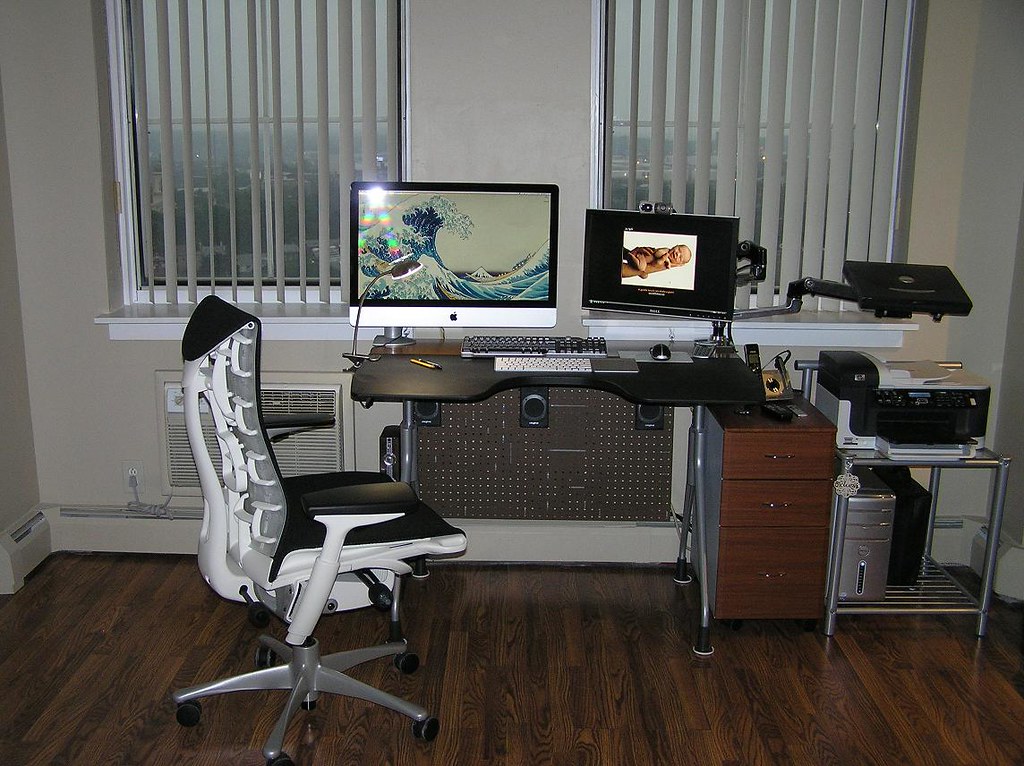
The good news is that the sub-$300 tier has gotten genuinely good. A decade ago, “budget ergonomic chair” mostly meant a flimsy mesh seat with a fixed back. Today you can find adjustable lumbar support, multi-directional armrests, seat-depth sliders, and breathable mesh well under the $300 mark. Below are five real, currently sold chairs that balance support and small-space practicality, plus exactly what to look for so you can shop confidently even if a specific model sells out.
Disclosure: TinyOfficeLab is reader-supported. As an Amazon Associate we earn from qualifying purchases. This costs you nothing extra and never changes our picks.
For more on squeezing a real workspace into tight quarters, see our companion guides: Best Compact Ergonomic Chairs for Small Apartments and Best Ergonomic Chairs for Petite / Short People.
What to Look For in a Sub-$300 Chair (Especially as a Renter)
Spending less doesn’t mean settling for less, but it does mean knowing where the money goes. Here’s how we evaluate chairs in this tier.
Lumbar Support That Actually Adjusts
The single most important feature at any price is lumbar support that meets the natural inward curve of your lower back. Cheap chairs often have a fixed bump that may or may not land where your spine needs it. Look for lumbar that adjusts in height (so it lines up with your beltline rather than your shoulder blades) and ideally in depth (how firmly it presses in). Some chairs now use “dynamic” or weight-sensing lumbar that flexes as you move, which removes some guesswork.
Adjustability Beyond Just Seat Height
Every chair raises and lowers. What separates an ergonomic chair from an office throwaway is the rest: armrest height (and ideally 3D or 4D movement so your forearms rest level with your desk), seat-depth adjustment (so the seat edge doesn’t dig into the back of your knees), and a recline you can lock or tension to your body weight. The more of these a chair has at this price, the better the long-term value.
Build Quality and Base
A chair you’ll sit in 40-plus hours a week needs a base that won’t wobble. Favor a metal (steel or aluminum) five-star base over all-plastic. Check the stated weight capacity — most quality chairs here support 300 to 330 pounds, and a higher rating is usually a sign of sturdier internals. Casters matter too: many chairs ship with hard plastic wheels that can scuff or grind on apartment hardwood, so factor in a cheap set of rubberized rollerblade-style casters if you’re protecting a floor (and a security deposit).
Footprint and Footprint Honesty
This is where renters get burned. A “high-back” ergonomic chair is taller and often pushes back further when reclined. For small spaces, watch two numbers: the base diameter (the five-star footprint, usually around 27 inches) and the overall depth at full recline. A mesh back reads visually lighter than a padded executive throne and helps a cramped room feel less crowded. If you’re tucking the chair under a desk when not in use, confirm the armrests drop low enough to clear the desktop.
Mesh vs. Cushion
Full-mesh chairs breathe well and feel airy in a small room — great if your apartment runs warm or lacks great airflow. A foam or hybrid seat tends to feel more plush for long sits. Neither is “better”; it’s about your climate and how many hours you log.
Our Top Picks Under $300
We selected these for the combination renters care about: real lumbar support, meaningful adjustability, a sensible footprint, and a price that lives at or below the $300 line. Prices in this category move constantly with sales and coupons, so treat everything below as the “around or under $300” tier rather than a fixed number — always confirm the current price before buying.
1. Sihoo Doro C300 — Best Overall Value
The Doro C300 has become a sub-$300 favorite for a reason: it brings features you’d normally expect a tier up. Its standout is a dynamic, weight-sensing lumbar system that adjusts support depth as you shift and recline, so you spend less time fiddling with knobs. It pairs that with soft 3D armrests, an adjustable headrest, and a breathable mesh back.
For renters, the mesh back keeps it visually light in a small room, and the full adjustability means it can fit a range of body types if your space is shared. It’s a fuller-size chair rather than a mini, so measure your corner, but the footprint is standard for an office chair. Owner feedback consistently praises the lumbar feel and easy assembly; the most common gripe is that the auto-lumbar suits some backs better than others, which is true of any non-manual system.
- Dynamic weight-sensing lumbar, adjustable headrest, 3D armrests, mesh back
- Roughly 300 lb weight capacity
- Best for: most renters who want the strongest all-around value
2. FlexiSpot OC3 — Best for a Plusher Seat in a Small Room
If you find all-mesh seats too firm, the OC3 splits the difference with a breathable mesh back and a foam-cushioned seat. It keeps the ergonomic essentials — adjustable lumbar support, 3D armrests, a 2D adjustable headrest, and a lockable backrest so you can set your recline and leave it.
It’s a strong pick for a renter who wants long-sit comfort without the bulk of a padded executive chair. The mesh back keeps the visual profile slim, while the cushioned seat is friendlier for people who feel pressure points on mesh after a few hours. Owners like the value and the seat comfort; as with most chairs at this price, expect to spend 20–30 minutes on assembly.
- Mesh back with foam seat cushion, adjustable lumbar, 3D armrests, 2D headrest, lockable backrest
- Roughly 300 lb weight capacity
- Best for: renters who want cushion comfort and a compact look
3. Sihoo M57 — Best Budget Full-Mesh Option
The M57 is one of the most affordable ways to get a legitimately adjustable mesh chair, often landing well below the $300 ceiling. You get height- and depth-adjustable lumbar support, an adjustable headrest that tilts and lifts, 3D armrests, and a recline of up to roughly 126 degrees. It’s rated to about 330 pounds, which speaks to a sturdier-than-expected frame with a reinforced aluminum base.
For a renter on a tighter budget, this is the “do the fundamentals well” choice. The full-mesh build is airy and light in a small space, and it’s a frequent recommendation as a first real ergonomic chair. The trade-off versus pricier picks is a firmer, no-cushion mesh seat and slightly less refined adjustment feel — reasonable concessions at this price.
- Height/depth-adjustable lumbar, adjustable headrest, 3D armrests, ~126° recline, full mesh
- About 330 lb weight capacity, reinforced aluminum base
- Best for: budget-focused renters who still want real adjustability
4. Nouhaus Ergo3D — Best for Dialed-In Armrest and Tilt Control
The Ergo3D is a popular high-back mesh chair known for its 4D adjustable armrests (height, depth, width, and pivot) and a multi-lock tilt mechanism that lets you fix the recline at several points. It also includes an adjustable headrest and lumbar support in a breathable mesh package.
The 4D arms are the headline for renters who do a lot of mixed work — typing, then leaning back to read or take calls — because you can position your forearms precisely instead of living with one fixed angle. It’s a taller chair, so it suits a desk setup more than a dining-table improvisation; if your ceiling-to-desk space is tight, check the headrest height. Owners highlight the armrest range and overall comfort.
- 4D armrests, multi-lock tilt, adjustable headrest, lumbar support, high-back mesh
- Best for: renters who want precise armrest and recline control
5. Hbada E3 Air — Best for Fit Flexibility (Taller or Shorter Users)
The E3 Air is built around adaptability, which makes it a smart pick when one chair has to serve more than one person — common in a shared rental. It features a 3-zone dynamic lumbar you can position vertically to meet your spine, a sliding seat-depth adjustment (roughly 2 inches of travel), a 3D adjustable headrest, and 3D armrests. Hbada positions the E3 line for a wide height range, and it carries a higher weight rating around 330 pounds.
The seat-depth slider is the renter-friendly star here: if your legs are shorter or longer than average, you can stop the seat edge from cutting off circulation behind your knees without buying a different chair. It’s a full-size chair with a roughly 27.5-inch-square footprint, so measure before committing in a very tight nook.
- 3-zone dynamic lumbar, ~2″ seat-depth slider, 3D headrest, 3D armrests, full mesh
- Around 330 lb weight capacity, fits a wide height range
- Best for: shared spaces and users at the shorter or taller ends
Worth a Look: Branch Verve — Best Style for a Visible Room
If your “office” is a corner of the living room where guests will see it, the Branch Verve is worth a mention for its clean, low-profile silhouette and pop-of-color options. It offers tilt with tilt-lock, seat-height and seat-depth adjustment, height-adjustable armrests, and height-adjustable lumbar support, with a synchronous base mechanism. It’s sold primarily through Branch directly and sits right around the top of this price tier, so confirm current pricing.
- Tilt lock, seat-depth and armrest-height adjustment, height-adjustable lumbar, low-profile design
- About 300 lb weight capacity
- Best for: renters who want a design-forward chair in a visible space
Quick Comparison
| Chair | Lumbar | Armrests | Seat | Footprint Note | Best For |
|---|---|---|---|---|---|
| Sihoo Doro C300 | Dynamic, weight-sensing | 3D | Mesh | Standard full-size | Best overall value |
| FlexiSpot OC3 | Adjustable | 3D | Foam cushion | Slim mesh back | Plusher seat, small room |
| Sihoo M57 | Height + depth adjustable | 3D | Full mesh | Airy, light profile | Tightest budget |
| Nouhaus Ergo3D | Adjustable | 4D | Full mesh | Tall high-back | Armrest/tilt control |
| Hbada E3 Air | 3-zone dynamic | 3D | Full mesh | ~27.5″ square | Fit flexibility, shared use |
How to Make Any of These Work in a Small Rental
A few habits go a long way once your chair arrives. Measure your recline depth, not just the chair’s resting footprint — reclined, a high-back chair needs clearance behind it, so position it where a wall or bookshelf won’t get scuffed. Swap the casters if you have hardwood or laminate; soft rubberized wheels protect floors (and deposits) and roll more quietly for neighbors below. Set the seat height first so your feet rest flat and your thighs are roughly parallel to the floor, then dial in lumbar height to your beltline, then armrests so your shoulders relax. And if floor space is truly precious, choose a chair whose arms drop low enough to slide fully under your desk when you’re done for the day.
Frequently Asked Questions
Can you really get a good ergonomic chair under $300?
Yes. The sub-$300 tier now includes adjustable lumbar support, multi-directional armrests, seat-depth sliders, and breathable mesh — features that were premium-only a few years ago. You won’t get the 12-year warranties or refined feel of a $1,000 chair, but for most renters the support-to-price ratio at this level is excellent.
Mesh or cushioned seat for a small apartment?
Mesh breathes better and reads visually lighter, which helps a cramped room feel more open and keeps you cool if your space runs warm. A foam seat (like the FlexiSpot OC3) feels plusher for long sits. If you log many hours and feel pressure points on mesh, lean cushion; otherwise mesh is a great small-space default.
What footprint should I expect?
Most full-size ergonomic chairs here have a base around 27 inches across. The number renters forget is recline depth — a high-back chair pushes further back when you lean. Measure the spot where the chair will live, including room to recline, before you buy.
Will these chairs damage my apartment floors?
The stock hard-plastic casters on many budget chairs can scuff or scratch hardwood and laminate. A $15–$25 set of rubberized rollerblade-style casters fits most of these chairs and protects your floor — a cheap insurance policy on your deposit.
Are these chairs easy to move and reassemble?
Generally yes. Most ship in a single box and assemble in 20–30 minutes with included tools. They break back down for a move, though mesh-and-metal chairs are heavier than they look (often 40–50+ pounds), so plan accordingly on moving day.
Which one should I buy?
For the best all-around value, start with the Sihoo Doro C300. Want a softer seat, go FlexiSpot OC3. Tightest budget, the Sihoo M57. Need precise armrest control, the Nouhaus Ergo3D. Sharing the chair across different body types, the Hbada E3 Air.
Prices and availability in this category change frequently, so confirm the current listing and specs before purchasing. For more tailored picks, explore Best Compact Ergonomic Chairs for Small Apartments and Best Ergonomic Chairs for Petite / Short People.